WIE @ 2026 IEEE Real Time Conference

The 2026 IEEE Real Time Conference took place from May 25 to May 29 in La Biodola on the beautiful island of Elba, Italy. As we do for most NPSS conferences, we hosted a Women in Engineering (WIE) event. This event is an opportunity to share, learn and expand our knowledge about inclusivity in our research groups, laboratories and workplaces.
The amazing staff of the Hermitage Hotel welcomed us with food and beverages. We started the event with a short explanation of the activity, and then we put our generous attendees to work. Because yes, this special session had our attendees discuss and share ideas on five very important subjects.
Each of the five tables was assigned a different theme as detailed below. For each of those themes, the attendees could add specific challenges, solutions, opportunities and impacts. Challenges are things that affect certain people and reduce their productivity and well-being, while solutions are things that help restore and build equity. Opportunities are things where the solution enables further improvement on productivity. For example, lithium-ion batteries enabled the proliferation of individual mobility devices, such as accessible electrical bicycles and scooters. Impacts are things where the solution reaches more than the people affected by the challenge. Think about wheelchair accessible spaces which are much easier to navigate with strollers and heavy luggage.
Attendees were free to navigate from one table to another over the 2-hour period. The tables each held a large poster with the theme and divided in four quadrants for each category. People could write on the poster or on post-it notes, and add their element to the appropriate theme and category. This sparked a great number of productive discussions between people from very different backgrounds. Much of these discussions were captured on our posters, which I summarize below.
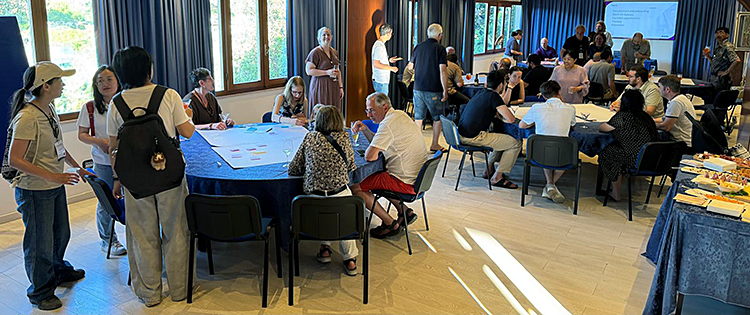
The first theme was Recruitment and onboarding. Bureaucracy, short timelines and lack of flexibility were highlighted as a significant challenge for a smooth onboarding experience. Conversely, attendees mentioned the possibility to recruit across all ages and offering retraining to fill in open positions. Attendees focussed particularly on the challenges in work-life balance limiting some options. Some suggested solutions including offering family friendly services, such as part-time parental leave, and multigenerational living communities. This would ensure financial needs are more easily met, increase productivity and quality of life across all life stages. There were also concerns about whether applicants feel pressured to tailor their research interests to available opportunities.
The second theme was Work-Life Balance, and here the presence of several of our attendees’ family members greatly enriched the discussion. Participants described a research culture that often rewards overwork. Issues included unrealistic expectations, pressure from supervisors and peers, work spilling into evenings and weekends, guilt associated with leaving work on time and insufficient time to complete doctoral studies. They also questioned whether work-life balance concerns are framed too narrowly as a women’s issue. The mobility requirements and language barriers were also mentioned and major challenges, underlining the stress related with finding work internationally in academia. Recommended actions included enforcing better boundaries around work communications and better relocation support and more flexible mobility expectations. There is also financial solutions, including relocation grants and extending parental leave support/grant timelines. Participants anticipated increased retention in research careers, more researchers with families, lower turnover, and a healthier, more innovative workforce
The third theme aimed to address the difficulties in ensuring equitable opportunities for everyone. The discussion centered on structural inequities in hiring, promotion, networking, and recognition. Concerns included bias in selection processes, difficulty networking for introverts and repeated nomination of the same individuals. There was also significant discussion around discrimination by tenured individuals who face little accountability and who have enormous power over career success. To improve the systemic issues, participants advocated for broader definitions of career success, anonymized application processes, more diverse paths to leadership positions, recognition of career gaps due to caregiving, and stronger minority representation targets. There was a clear call for addressing harmful behavior and improving accountability mechanisms, particularly for poor supervisors. The greatest opportunity identified was discovering and supporting “hidden talent” that traditional systems overlook. Other anticipated benefits included wider access to learning opportunities, and more inclusive organizational cultures.
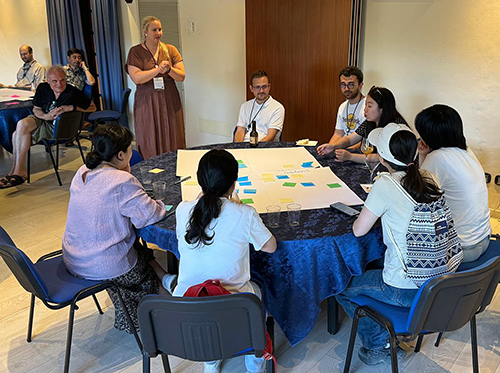
The fourth theme was Promotion, which addresses the inequities in accessing higher level positions. Participants identified many factors that can hinder advancement, including both intrinsic and environmental factors. Intrinsic factors included illness, ageism, and stereotypical assumptions about leadership capabilities of women and inequitable recognition of contributions. Environmental factors touched on lack of mentoring, work-life conflicts, and exclusionary “boys’ club” cultures. Key recommendations included blind recruitment practices, leadership coaching, stronger accountability for decision-makers and greater visibility of women leaders in STEM. Several solutions also echoed the Work-Life balance theme, suggesting mandatory parental leave for both parents, free childcare and hybrid participation options. Expected outcomes included reduced gender bias, improved retention, more innovative and flexible organizations, stronger institutional knowledge, and a workforce where individuals are better able to contribute according to their strengths.
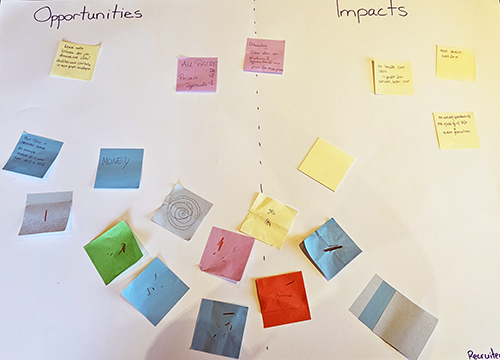
The fifth theme was Training, and we had several supervisors with a diverse experience background exchanging at this table. They expressed concerns about preparing supervisors for the challenge of mentoring, balancing personal and organizational goals, the instability caused by personnel turnover, unequal access to training opportunities, and the difficulty of reaching individuals whose behavior creates workplace problems. Suggested actions included providing resources and management support for training, improving doctoral programs, anonymizing competitive training applications, using broader success metrics, recognizing training as a valuable research contribution, promoting healthier work habits, and creating external mechanisms to address problematic behavior. Participants viewed training as a means to support both early-career and long-term development while building a larger, more capable talent pool.
What is particularly interesting to note is that across all five themes, several recurring priorities emerged. All participants agreed that more flexible working arrangements and better support for caregiving responsibilities are critical for improving productivity and happiness. A call for a broader definition of career success and reduction of bias in hiring, training opportunities, evaluation, and promotion was made unanimously. Building an inclusive workplace culture is a way to strengthen innovation, productivity, and workplace well-being, and this requires improved accountability and leadership quality, particularly among supervisors and senior researchers.
The IEEE Real Time conference is a conference with about 150-200 people, and the gender disparity is large, with only a few dozen people not identifying as men. This means it is particularly important to make sure men know they are welcome at our events (ALL our events!) and are necessary to have a truly inclusive discussion to improve the sense of belonging for all. We also had a fantastic opportunity in Elba, where we had a strong presence of companions, who were also invited at the WIE event. This resulted in the widest age range attendance in known memory, with the youngest only a few months old! We also had an amazing geographic diversity, which really enriched the discussions by bringing challenges and solutions that may not be present everywhere. In total we had about 50 attendees, which is a significant proportion of total attendees. The event lasted about two hours, after which people continued the conversation over dinner.
We would like to extend thanks to the Hotel Hermitage staff, the IEEE Real Time Conference support staff, the CANPS committee and all the attendees who made this event a wonderful success. See you in 2028 in Sherbrooke, Canada!
If you have an idea you want to submit to the NPSS WIE committee, or want support for your WIE event, you can contact us through the webpage.
Audrey Corbeil Therrien can be reached by email ay [email protected]