Real Time Conference 2026 (RT2026) — Elba Island, Italy
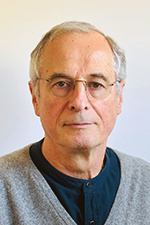
Following the RT2024 Asia meeting in Quy Nhon, Vietnam, the Real Time conference series returned to Europe with RT2026, which was held on Elba Island, Italy from May 25 to 29.
The venue, La Biodola, nestled on the island’s northern coast, offered an ideal combination of a focused working atmosphere and a welcoming natural setting — all enhanced by consistently fine weather and excellent conference facilities.
The local organizing committee deserves warm recognition for their tireless dedication and the positive energy they brought throughout the week, with particular thanks to Dr. Luca Galli (conference chair) and Eduardo Bossini (co-chair) for making RT2026 such a memorable event.
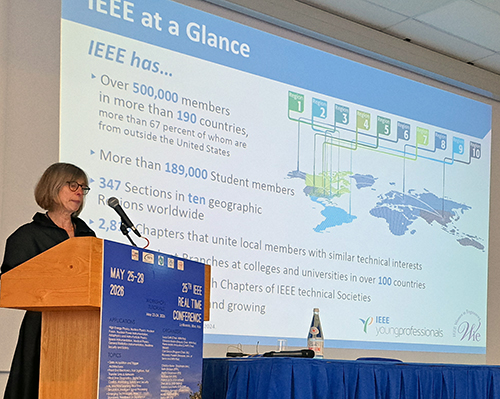
Prior to the official opening of the conference, Dr. Vesna Sossi, IEEE Division IV Director, delivered an engaging presentation outlining the mission and value of the IEEE society — setting an inspiring tone for the week ahead.
RT2026 marked a milestone for the series, becoming the first edition to surpass 200 participants. Attendees represented 18 countries, with students making up approximately one-third of the total. The geographic spread was notably even, with roughly half of participants coming from Asia and the other half from the rest of the world.
The conference opened with a two-day pre-conference short course on AI for Embedded Systems, drawing more than 20 participants. The course was led by Dr. Audrey Corbeil Therrien (Université de Sherbrooke, Canada), with hands-on laboratory sessions delivered by Benjamin Ramhorst (ETH Zürich, Switzerland) covering the use of hls4ml and the Coyote V2 open-source abstraction and infrastructure framework for FPGAs — a particularly timely topic given the growing role of machine learning across the field. Indeed, spanning topics from Control and Diagnostics to Data Acquisition and Front-End Electronics, the main technical program made clear that machine learning is fast becoming an indispensable tool — with nearly every session touching on its potential applications.
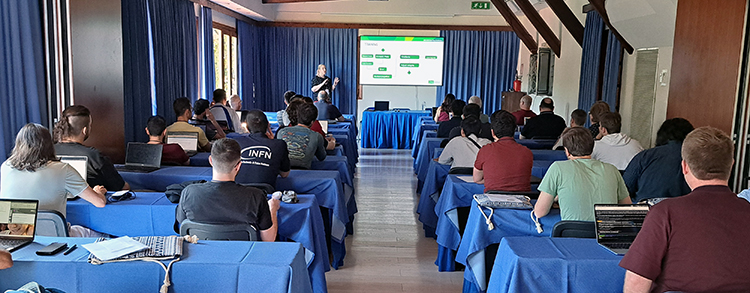
Highlighting the invited speaker programme were four standout presentations. Dr. Qiyu Peng from Shenzhen Bay Laboratory shared an exciting look at the next generation of PET imaging, followed by Dr. Thea Aarestad of the University of Zurich, who gave a wide-ranging overview of how AI and ML are being deployed at the LHC. Dr. Axel Winter from the Institut für Plasmaphysik Greifswald then tackled the formidable real-time control challenges posed by nuclear fusion, and Dr. Alberto Gennai closed with a thorough exploration of real-time monitoring for the Virgo superattenuators. The audience response to all four talks was noticeably enthusiastic, with questions and discussion extending well beyond the allotted time.
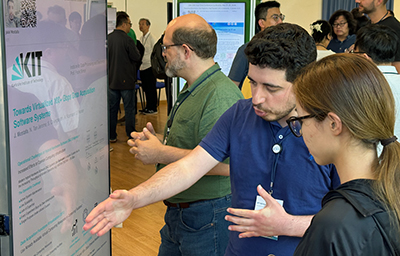
Given the high volume of contributions, the programme incorporated multiple poster sessions, each preceded by a “mini-oral” round in which presenters had a few minutes to highlight their work and invite attendees to their poster. This format proved highly effective, allowing participants to quickly identify the posters most relevant to their interests before navigating the floor. A notable innovation at RT2026 was the use of portrait flat-screen displays in place of traditional paper posters, lending the sessions a cleaner, more modern aesthetic in keeping with the spirit of the conference.
Promoting Women in Engineering (WIE) is a long-standing commitment of the CANPS committee, addressed at each conference through a dedicated session open to all attendees. At RT2026, this session was led by Dr. Audrey Corbeil Therrien in her role as WIE contact and drew an engaged audience of more than 30 participants.
Running alongside the technical programme, an industry exhibition proved equally stimulating, generating lively exchanges between exhibitors and attendees. Companies represented included SERTICS Technology Co. (China), as well as ELAD SRL, DF Elettronica SRL, Nuclear Instruments SRL, and CAEN SpA, all from Italy.
One highlight of the conference banquet was the presentation of the Student Award for the outstanding poster or oral paper. This year’s award went to María Molina-Delicado for her contribution “Towards a Central Trigger Processor for the CTAO LST Advanced Camera: Prototype Design and Hardware Validation”.
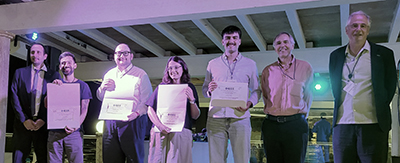
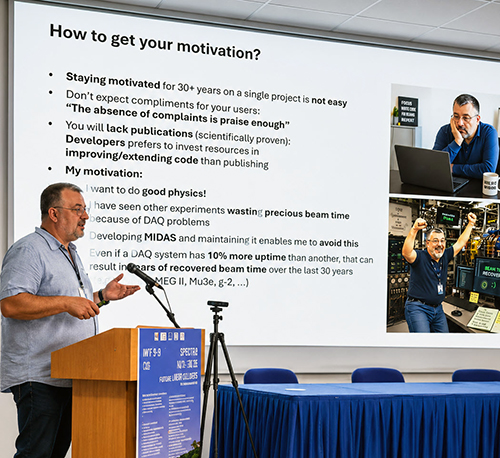
The second highlight was the CANPS Award, which recognises, at each Real Time conference, an individual who has made outstanding contributions to the field of Computer Applications in Nuclear and Plasma Science. This year’s recipient is Dr. Stefan Ritt of the Paul Scherrer Institute (PSI), Switzerland — a thoroughly well-deserved honor in recognition of his long-standing and impactful work within the community. Congratulations, Stefan.
Finally, the closing session brought an eagerly awaited announcement: the next Real Time conference will cross the Atlantic, heading to Sherbrooke, QC, Canada in 2028. We look forward to seeing everyone there.
Pierre-André Amaudruz, CANPS Chair, can be reached at [email protected]