The University of Osaka Hamadohri Environmental Radiation Measurements International School 2026
Each year, the University of Osaka Fukushima Center in Okuma, Japan, hosts three Environmental Radiation Measurement schools near the Fukushima Daiichi Nuclear Power Station. Two are conducted in Japanese, while one international school is taught in English for students from around the world. This year’s international school was held July 19 – 24, 2026. The measurement component of the school is organized jointly by the University of Osaka and the IEEE NPSS Educational Committee (EduCom). EduCom also partially funds the international school and supported four of this year’s lecturers. The goal of the school is not only to teach radiation measurements, but also to expose students to the scientific, engineering, and societal aspects of recovering from a major nuclear accident. The measurements performed at the school were developed and conducted in collaboration between the University of Osaka and IEEE/NPSS EduCom.
The school was conducted by 9 lecturers and supported by 3 staff members from the University of Osaka. Dr. Masaharu Nomachi from the University of Osaka was the lead organizer of the school.
We received a total of 57 student applications, with 26 students finally selected to attend the school. EduCom sponsored 7 students, which were chosen based on the application information and Zoom interviews. Although gender was not considered in the selection process, the final group of participants turned out to be well balanced in terms of gender.
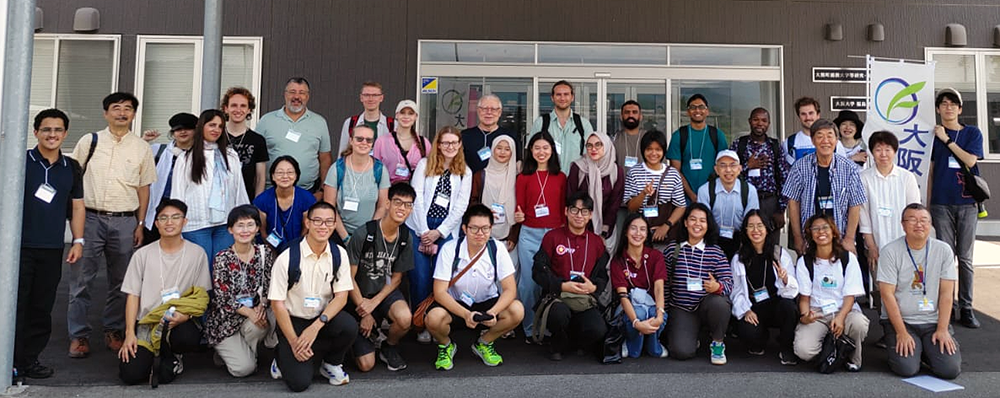
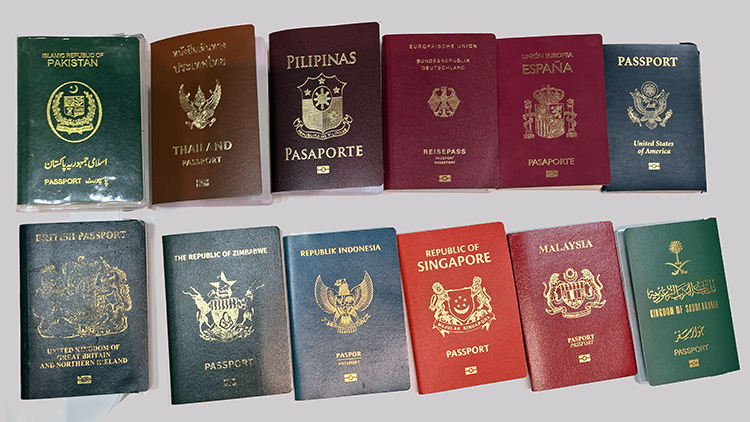
The participants came from a diverse range of academic disciplines: Physics and Medical Physics, Nuclear Engineering, IT, Teacher Education, and several more, including one Law student and one Psychologist. The school also lived up to its “international” name: The participants and lecturers came from 12 countries and represented 14 nationalities.
The first morning started with a tour of the Great East Japan Earthquake and Nuclear Disaster Memorial Museum, which is about 2.5 miles away from the Fukushima Power Station. The museum provides historical context for the earthquake, tsunami, and nuclear accident before the students began their field measurements. In the afternoon we had the first lectures, giving a brief overview of the different types of radiation, their impact on cells (and humans), the concept of half-life of radioactive nuclei, and some measurement methods. Lecturer Dr. Takeshi Koike then explained the soil sampling protocols and procedures for the next day (Fig. 3), when we would go to an area (Chuodai-Otozawa) designated as “hard to return to”, meaning that the contaminated top soil layer has not yet been removed in the cleanup efforts after the meltdown.
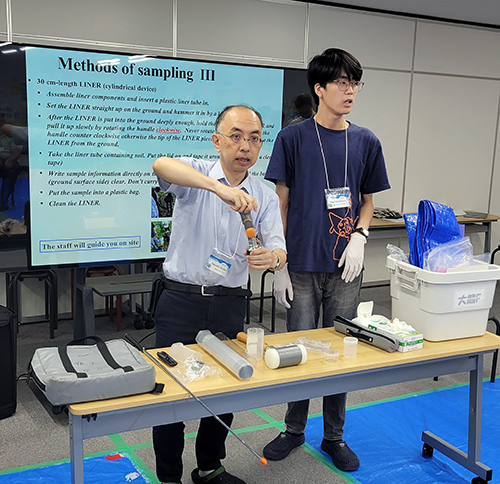
Each student received a “RadiaCode” monitor device, a small commercial radiation measurement device that can interface with a phone app. An extensive software infrastructure exists to analyze counts, spectra, radiation maps, and the like. Using the RadiaCode devices and later other NaI(Tl)-based scintillators, the students measured air dose rates on location, the depth profile of the contamination in a soil core approximately 30cm deep, and the activity in the collected soil and plants.
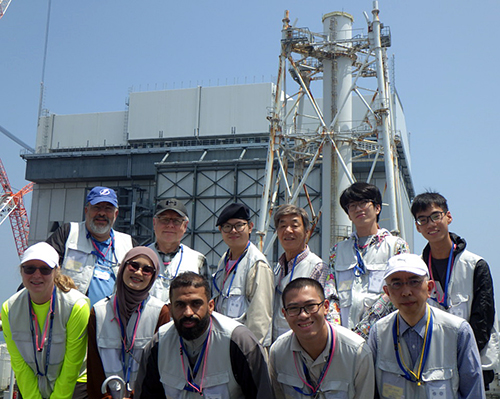
The next day we visited the actual Fukushima Power Station on a tour organized and guided by TEPCO (Fig. 4), which still owns the power station and is responsible for the cleanup efforts. We learned about the evolving plans to remove the molten fuel rods from the bottom of the pressure containments, as well as the used fuel elements that remain stored in the reactor complex. We also learned about “ALPS”, the “Advanced Liquid Processing System”, which removes radioactive material from water that gets continuously pumped from the area, until the remaining activity is well below the legal limits. This works for chemically different isotopes such as 90Sr, but not for the chemically identical Tritium (3H). The treated water still contains high levels of Tritium and gets diluted with sea water until the concentration is below the legal limits for discharge. While not uncontroversial, this is the only viable way to be able to discharge the water from the plant.
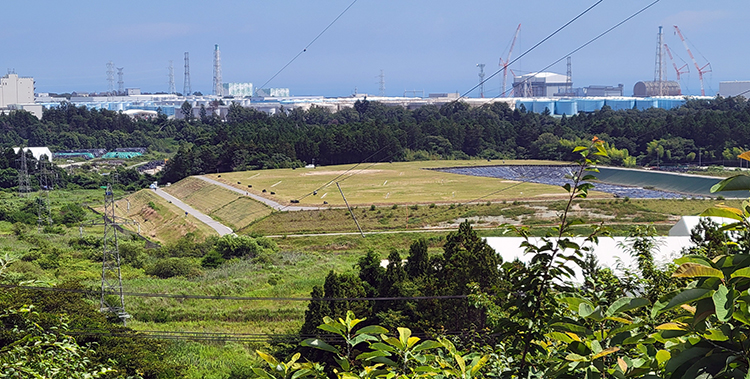
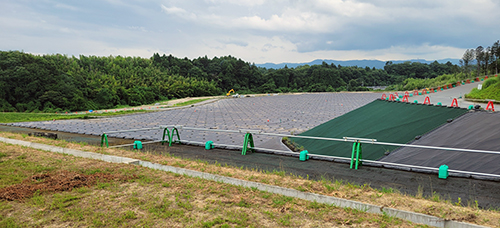
The next day we visited the “Interim Storage Facility” (ISF). Over hundreds of square miles, contaminated soil was removed, cleaned of plant matter, and is now stored at the ISF, football field-sized areas with layers of removed soil. It is capped with plastic, and later with a layer of uncontaminated soil, already completed for parts of the facility.
On the way back we visited a fish farm that got destroyed by the tsunami, and an elementary school that got evacuated and has never been used since. After the decontamination work, the evacuation order was lifted in most areas. We had the opportunity to look through the windows of the classrooms that are frozen in time.
Later that day we had the opportunity to speak to local people that lived in the area in 2011 and returned later. Among them was a man growing fruit locally. He told us of his struggles to overcome the stigma of fruit grown in the former contamination area (although the radiation levels are by now not different from elsewhere in Japan), but also about the problem that the best arable soil had been removed in the cleanup efforts, leaving the area with lower-quality soil. We also heard some first-hand accounts from March 11, 2011 and the days after.
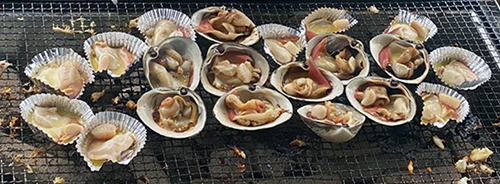
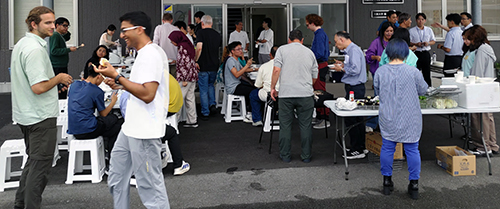
That evening students and organizers enjoyed a barbecue featuring local seafood and other local delicacies.
On the last day we had a closing session where the students gave their impressions of the school, what they learned, and what they liked. The closing session demonstrated how much the participants had learned during the week and highlighted the value of bringing together students from many countries and academic backgrounds to study radiation science in its real-world context. For the lecturers, it was nice to see how the students from so many different countries and cultures formed a class community and started working together from the first day.
This program was conducted in collaboration with Okuma Town. We would like to express our sincere gratitude to Okuma Town for its support.
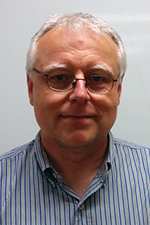
Martin Purschke (Brookhaven National Laboratory) was one of the lecturers at the school. He can be reached at [email protected].