Nuclear and Space Radiation Effects News
Nominations for 2027 Awards
Nominations are due January 31, 2027, for awards that will be presented at the IEEE NSREC 2027 Conference, July 19 – 23, in Atlanta, Georgia.
Radiation Effects Award Nominations
Nominations are currently being accepted for the 2027 IEEE Nuclear and Plasma Sciences Society (NPSS) Radiation Effects Award. The purpose of the award is to recognize individuals who have had a sustained history of outstanding and innovative technical and/or leadership contributions to the radiation effects community. The $3000 cash award and plaque will be presented at NSREC Atlanta, Georgia.
Forms are available electronically at http://ieee-npss.org/technical-committees/radiation-effects/ and must be submitted by January 31, 2027. Additional information can be obtained from Justin Likar, Senior Member-at-Large, JHU/APL, for the Radiation Effects Steering Group. Justin can be reached at [email protected]
Radiation Effects Early Achievement Award Nominations
Nominations are currently being accepted for the 2027 Radiation Effects Early Achievement Award. The purpose of this award is to recognize an individual early in his or her career whose technical contributions and leadership have had a significant impact on the field of radiation effects. The $1500 cash award and plaque will be presented at NSREC Atlanta, Georgia.
Forms are available electronically at http://ieee-npss.org/technical-committees/radiation-effects/ and must be submitted by January 31, 2027. Additional information can be obtained from Justin Likar, Senior Member-at-Large, JHU/APL, for the Radiation Effects Steering Group. Justin can be reached at [email protected]
Paul Phelps Continuing Education Grant Nominations
Nominations are currently being accepted for the 2027 Paul Phelps Continuing Education Grant. The purpose of the grant is to promote continuing education (attendance at the 2027 NSREC Short Course) and encourage membership in NPSS. Outstanding members of NPSS who are either Student Members, Post-Doctoral Fellows or Research Associates, or unemployed members needing assistance in changing career direction can be nominated for the award. The actual amount of the grant will be determined prior to the 2027 NSREC in Atlanta, Georgia. Funds are to be used towards covering travel costs to attend the NSREC Short Course. The grant also provides complimentary short course registration.
Nomination forms are available electronically at http://ieee-npss.org/technical-committees/radiation-effects/ and must be submitted by January 31, 2027. Additional information can be obtained from George Tzintzarov, Member-at-Large, Aerospace Corp., for the Radiation Effects Steering Group. George can be reached at [email protected]
2027 IEEE NSREC Is Planning for Atlanta, Georgia
Chair Jonathan Pellish invites you to NSREC 2027, to be held at The Westin Peachtree Plaza in Atlanta, Georgia, July 19 – 23, 2027.
The 2027 NSREC will be held in the heart of downtown Atlanta, Georgia. Known as “The City in the Forest” and the cultural capital of the South, Atlanta is a city defined by history, innovation, and Southern hospitality.
Few cities in the world are easier to reach. Hartsfield-Jackson International Airport is consistently ranked among the most well-connected airports globally, with nonstop flights to destinations across six continents, and links directly to downtown via the city’s MARTA rail system, with a stop just steps from the Westin.
The cradle of the modern civil rights movement and the birthplace of Coca-Cola, Atlanta has left an indelible mark on the national story. The Martin Luther King, Jr. National Historical Park, the National Center for Civil and Human Rights, the World of Coca-Cola, and Centennial Olympic Park, host of the 1996 Games, are all within walking distance of the hotel. The city is also home to more than fifty colleges and universities including Georgia Tech, Emory University, and the Atlanta University Center, fostering a thriving research ecosystem in aerospace, microelectronics, and defense.
Beyond its landmarks, Atlanta rewards exploration. Walk through a glass tunnel as whale sharks glide overhead at the Georgia Aquarium, the largest in the United States and just blocks from the Westin. Stroll the Atlanta BeltLine, threading through vibrant neighborhoods lined with street art, live music, and outstanding dining. Escape to Piedmont Park for sweeping views of the Midtown skyline above the tree canopy. World-class restaurants, a thriving music scene, and genuine Southern hospitality complete the experience.
We look forward to welcoming you to Atlanta in 2027 for an outstanding technical program in a truly dynamic city.
Abstracts must be received by 23:59 (local time) on Friday, February 5, 2027. Detailed submission instructions will be available after Tuesday, December 1, 2026. Visit www.nsrec.com.
Technical Program
Chaired by Enxia Zhang, University of Central Florida, papers to be presented at this meeting will describe the effects of space, terrestrial, or nuclear radiation on electronic or photonic devices, circuits, sensors, materials and systems, as well as semiconductor processing technology and techniques for producing radiation-tolerant devices and integrated circuits. The conference will be attended by engineers, scientists, and managers who are concerned with radiation effects.
The conference committee is soliciting papers describing significant new findings in the following or related areas:
Basic Mechanisms of Radiation Effects in Electronic Materials and Devices
- Single Event Charge Collection Phenomena and Mechanisms
- Radiation Transport, Energy Deposition and Dosimetry
- Ionizing Radiation Effects
- Materials and Device Effects
- Displacement Damage
- Processing-Induced Radiation Effects
Radiation Effects on Electronic and Photonic Devices and Circuits
- Single Event Effects
- MOS, Bipolar and Advanced Technologies
- Power Devices and Wide Bandgap Materials
- Isolation Technologies, such as SOI and SOS
- Optoelectronic and Optical Devices and Systems
- Methods for Hardened Design and Manufacturing
- Modeling of Devices, Circuits and Systems
- Cryogenic or High Temperature Effects
- Novel Device Structures, such as MEMS and Nanotechnologies
- Techniques for Hardening Circuits and Systems
Space, Atmospheric, and Terrestrial Radiation Effects
- Characterization and Modeling of Radiation Environments
- Space Weather Events and Effects
- Spacecraft Charging
- Predicting and Verifying Soft Error Rates (SER)
Hardness Assurance Technology and Testing
- New Modeling and Testing Techniques, Guidelines and Hardness Assurance Methodology
- Unique Radiation Exposure Facilities or Novel Instrumentation Methods
- Dosimetry
New Developments of Interest to the Radiation Effects Community
Radiation Effects Data Workshop
The Radiation Effects Data Workshop is a forum for papers on radiation effects data on electronic devices and systems. Workshop papers are intended to provide radiation response data to scientists and engineers who use electronic devices in a radiation environment, and for designers of radiation-hardened or radiation-tolerant systems. Papers describing new simulation facilities are also welcomed.
Paper Submittal
Information on the submission of summaries to the 2027 NSREC for either the Technical Sessions or the Data Workshop can be found at www.nsrec.com. The deadline for submitting summaries is February 5, 2027.
Short Course
Attendees will have the opportunity to participate in a one-day Short Course on Monday, July 19th. The short course is being organized by Megan Casey, Columbus Technologies & Services/NASA GSFC. The course will be of interest both to radiation effects specialists and newcomers to the field.
Industrial Exhibit
An Industrial Exhibit will be included as an integral part of the conference. Exhibitors will include companies or agencies involved in manufacturing electronic devices or systems for applications in space or nuclear environments, modeling and analysis of radiation effects at the device and system level, and radiation testing. Exhibit and Supporter Registration will open in October.
Conference Committee
- General Chair — Jonny Pellish, IEEE Senior Member, [email protected]
- Technical Program Chair — Enxia Zhang, University of Central Florida, [email protected]
- Short Course Chair — Megan Casey, Columbus Technologies & Services / NASA GSFC, [email protected]
- Local Arrangements Chair — Adrian Ildefonso, Indiana University-Bloomington, [email protected]
- Publicity Chair — Adalin Benedetto, Alphacore Inc., [email protected]
- Finance Chair — Jennifer Taggart, Aerospace Corporation, [email protected]
- Awards Chair — Indranil Chatterjee, Airbus, [email protected]
- Web Developer — Greg Allen, Jet Propulsion Laboratory, [email protected]
2026 Phelps Award Winners
The 2026 Paul Phelps Continuing Education Grant was awarded to four student members from the radiation effects community. At the opening of the NSREC Conference (July 20, 2026), Kay Chesnut, Chair of the Radiation Effects Steering Group, announced the grant awards. The grants included tuition for the 2026 NSREC Short Course and a $750 travel reimbursement.
The purpose of the Phelps Grant is to promote continuing education and encourage membership in the Nuclear and Plasma Sciences Society (NPSS). The criteria for judging are exceptional promise as a student, postdoc or research associate in any of the fields of NPSS, or exceptional work in those fields by currently unemployed NPSS members with an expectation that attendance at the Short Course will improve the possibility of obtaining a job in an NPSS field.
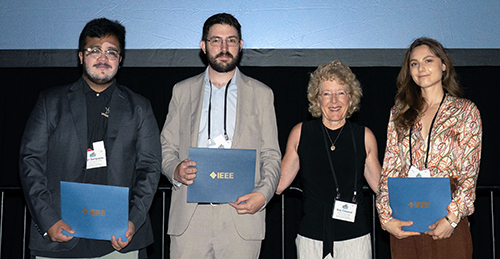
Dr. Arijit Sengupta, Vanderbilt University, USA, is a postdoctoral research fellow and semiconductor specialist dedicated to enhancing the reliability of power electronics for the future of sustainable aviation and space exploration. He holds a Ph.D. from Vanderbilt University, where he focused on the behavior of wide bandgap (SiC/GaN) power devices in extreme radiation environments. His research bridges the gap between semiconductor device physics and the practical requirements of high-reliability mission architecture. He has contributed to international space initiatives as an alumnus of the NASA JPL Planetary Science Summer School and the NASA L’SPACE Academy, where he gained expertise in mission operations and lunar surface innovation. Currently, he is a research fellow at the German Aerospace Center (DLR), where he has been selected to lead a multi-institute project aimed at assessing the radiation effects on power electronic components for future electric aircraft. His mission is to advance high-performance, resilient power systems that support both the electrification of flight on Earth and the technical demands of deep-space exploration.
Brett Ringel, Georgia Institute of Technology, USA, received his B.S. and M.S. both in electrical and computer engineering from The Ohio State University, and recently defended his Ph. D thesis at the Georgia Tech Institute of Technology. His work focuses on both investigating the underlying physical mechanisms responsible for photonic device and circuit degradation in harsh space radiation environments and creating novel RF and photonic circuit designs for applications ranging from free-space optical communication systems to RF-over-fiber applications. For his efforts in the optimization of Si/SiGe BiCMOS radio frequency and photonic integrated circuits for performance and reliability in space environments through radiation hardening by design, he received the National Defense Science and Engineering Graduate Fellowship (NDSEG) in 2022. Brett is looking to leverage his background to contribute toward advancing the development, performance, and design of state-of-the-art RF and photonic integrated circuits, microwave systems, and components, to be used in the harsh space environment.
Joanna Krynski, University of Toulouse, France, is a PhD candidate at the Institut Supérieur de l’Aéronautique et de l’Espace (ISAE-SUPAERO), Université de Toulouse, and fully funded by the Centre National d’Etudes Spatiales (CNES) in Toulouse, France. Her research is focused on ultra-low noise image sensors for photon-counting applications, and the impact of radiation on such devices. Prior to her PhD, Joanna received her Master’s degree in Physics at the University of Waterloo in Waterloo, Canada, where she was investigating the irradiation and mitigation of radiation effects in single-photon avalanche diodes for quantum communication satellites. Fascinated by the invisible yet potent impact of radiation, Joanna has always been drawn to applications related to it, including space science, high energy physics experiments, as well as medical diagnostics and radiation therapy.
Luca Weninger, University of Saint Etienne, France, received his Bachelor’s degree in Ingegneria Elettronica at Università degli Studi di Modena e Reggio Emilia, Italy, in 2018. He then got his Master’s degree in Electronic Engineering at the same university in 2021. He performed a master thesis on optical fiber-based dosimetry. In October 2021, Luca started his doctorate at the Hubert Curien laboratory of University of Saint Etienne, France, inside the MOPERE research group. His PhD thesis’ main objective consists in studying and characterizing different fiber optic and microelectronic solutions for dosimetry and beam instrumentation at the radiation facilities involved in the RADNEXT project.
2026 Special Outreach
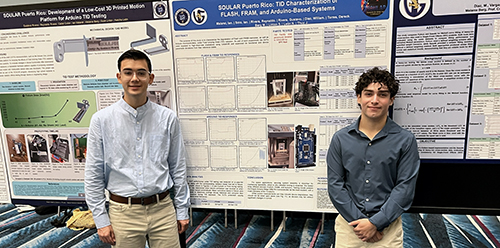
The Puerto Rico STEM education program has been working with Space R3 LLC to develop a series of microelectronics-based projects for high school students (ages 15–18). Participating students are from University Gardens High School and Papa Juan XXIII High School, both located in San Juan, Puerto Rico.
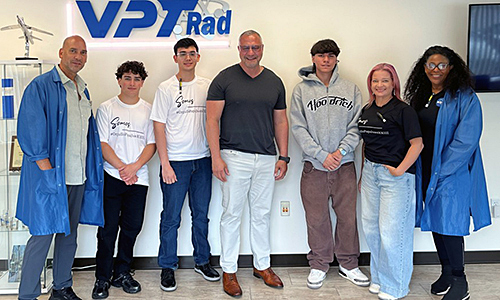
The projects span multiple disciplines, including mathematics, science, and engineering, with a strong emphasis on radiation effects in microelectronics. The program has run for approximately one academic year, beginning in September 2025 and concluding at the NSREC 2026 Conference. During this time, students and their teachers designed, built, and tested a variety of microelectronic systems. Guest speakers included Nicole Pothier McGillivray (Carrington Shield Strategies, LLC), Ricardo De Jesus (Raytheon), Lea Ann Smith (Radiation Test Solutions, Inc.), Nicholas Christian (Radiation Test Solutions, Inc.), and Melanie Berg (Space R3 LLC). Industry partners generously donated access to radiation testing facilities and shared their expertise. ProNova Solutions, LLC provided proton testing, VPT Rad, Inc. provided total ionizing dose (TID) testing, and Radiation Test Solutions, Inc. (RTS) provided neutron testing. The IEEE Nuclear and Plasma Sciences Society (NPSS) also provided generous financial support. Data acquisition was performed by Space R3 LLC in collaboration with Natch León of Papa Juan XXIII High School.
Three engineering students were selected to travel to the TID facility and participate in testing, while mathematics students received the resulting data and performed the analysis. The results will be presented by the students during a poster session at the NSREC 2026 Conference. NSREC 2026 has decided to reserve a dedicated spot in its POSTER SESSION for the STEM-PR students to present their work to the community.
Michael Campola, RE Vice Chair for Publicity, can be reached by E-mail at [email protected]