IEEE Transactions on Nuclear Science: 2025 Best Paper Award

The winners of the TNS 2025 Best Paper Award are D. M. Fleetwood, E. X. Zhang, R.D. Schrimpf, and S. T. Pantelides for their paper “Radiation Effects in AlGaN/GaN HEMTs” published in the IEEE Transactions on Nuclear Science, vol. 69, no. 5, May 2022, pp. 1105–1119, DOI 10.1109/TNS.2022.3147143.
The paper reviews displacement damage effects, total-ionizing-dose effects, and single-event effects in AlGaN/GaN high electron mobility transistors (HEMTs). It has been viewed over 4000 times and cited over 70 times since publication. The award ceremony was held during the 2025 Nuclear and Space Radiation Effects Conference (NSREC) in Nashville. Congratulations to the team of co-authors on this important accomplishment!
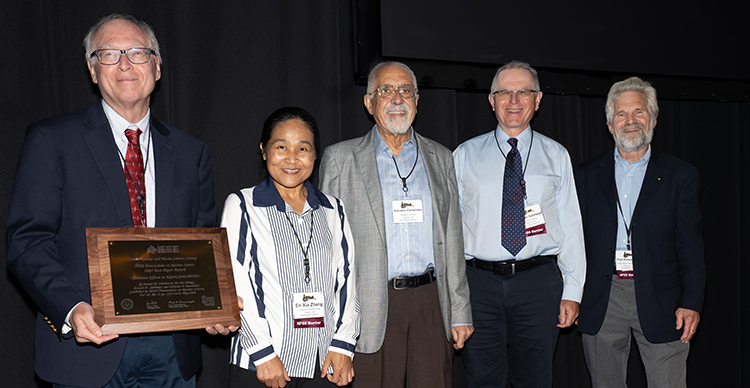

Daniel M. Fleetwood received his Ph.D. in Physics from Purdue University in 1984. He joined Sandia National Laboratories in Albuquerque, New Mexico, in 1984, and was named a Distinguished Member of the Technical Staff in the Radiation Technology and Assurance Department in 1990. In 1999 he accepted a position as Professor of Electrical Engineering at Vanderbilt University in Nashville, Tennessee. In 2000, he was also named a Professor of Physics. In July 2001 he was appointed Associate Dean for Research of the Vanderbilt School of Engineering, and from June 1, 2003, through June 30, 2020, he was Chair of the Electrical Engineering and Computer Science Department. Since 2009, he is appointed Landreth Chair of Engineering. His research focuses primarily on the radiation response and reliability of microelectronic materials and devices, and defects in microelectronic devices and materials. He has performed foundational studies using low-frequency noise and thermally stimulated current techniques to characterize and identify defects and impurities in a wide range of semiconducting and insulating materials. He also has contributed to several international standards for assessing and assuring the radiation response of microelectronic materials, devices, and integrated circuits for use in defense and space environments.

En Xia Zhang received her Ph.D. in Microelectronics and Solid-State Electronics from the Chinese Academy of Sciences in 2006, focusing on radiation effects in SOI technology. She joined Vanderbilt University as a Postdoctoral Research Associate in 2009 after serving as an Associate Professor at Shanghai University of Engineering Sciences. She was appointed Research Assistant Professor of Electrical Engineering in 2010 and promoted to Research Associate Professor of Electrical Engineering and of Materials Science and Engineering in 2017. In 2023, she joined the University of Central Florida (UCF) as an Assistant Professor. She also serves as program coordinator for the graduate Electronic Parts Engineering certificate program at UCF, in partnership with the NASA Electronic Parts and Packaging School. Her research focuses on radiation effects and reliability in microelectronic materials and devices, as well as defect characterization in semiconducting and insulating materials. Her work spans total-ionizing-dose effects, single-event effects, and charge collection in advanced devices, including nanoscale Si CMOS, CMOS/SOI, compound and wide bandgap semiconductors, and MOS devices based on various 2D and 3D materials. Her research has contributed significantly to the understanding and improvement of device performance in radiation-rich environments.

Ronald D. Schrimpf received his Ph.D. degree in Electrical Engineering from the University of Minnesota in 1986. He was a faculty member in Electrical and Computer Engineering at the University of Arizona from 1986-1996. Since 1996, he has been with Vanderbilt University, where he is a Professor of Electrical Engineering and a Professor of Materials Science and Engineering. He currently is appointed as Orrin Henry Ingram Professor of Engineering. He was the founding Director of the Institute for Space and Defense Electronics and served in that role from 2002-2022. His research focuses on reliability and survivability of electronics for use in extreme environments, particularly those in which they are exposed to high levels of radiation. His work has explored the connection between physical mechanisms related to radiation response and semiconductor device physics. He has worked on understanding and modeling enhanced low dose-rate sensitivity in bipolar devices, single-event burnout and single-event gate rupture in power devices, and radiation effects in wide bandgap semiconductor materials and devices.

Sokrates T. Pantelides received a PhD in theoretical physics from the University of Illinois in Urbana-Champaign in 1973. After two years at Stanford University, he joined the IBM Thomas J. Watson Research Center in New York, where he carried out research in semiconductors and served as manager, senior manager, and program director. In 1994 he joined the faculty at Vanderbilt University in Nashville, Tennessee, as William A. and Nancy F. McMinn Professor of Physics. In 1995 he was named Distinguished Visiting Scientist at Oak Ridge National Laboratory, where he maintained a group collaborating with electron microscopists until 2020.
In 2010 he was named University Distinguished Professor of Physics and Engineering and Professor of Electrical Engineering at Vanderbilt. In 2016 he was named Distinguished Visiting Professor of Physics at the University of the Chinese Academy of Sciences in Beijing, China, collaborating with scanning-tunneling microscopists. He has made pioneering contributions to the theory of defects in semiconductors and their roles in electronic devices. His work has helped to elucidate the defect-mediated response of electronic devices to ionizing radiation and single-event effects. Other research areas include structural, electronic, magnetic, optical, and thermal properties of complex nanostructures.
Gian-Franco Dalla Betta can be reached at [email protected].