Robots, Emotions and Culture: Insights into Japan

The IEEE Nuclear Science Symposium, Medical Imaging Conference and Room Temperature Semiconductor Detector Symposium (NSS MIC RTSD) held their annual conference in Yokohama Japan from November 2nd to November 8th, 2025.
On Wednesday November 5th, we held our Women in Engineering (WIE) Event, which consisted of three parts: an invited talk, a panel and a networking session. The event sparked interest among the conference participants and was attended by about a hundred people — 35/65% male/female ratio. The event was organized and chaired by Prof. Audrey Corbeil Therrien from the Université de Sherbrooke, Canada.
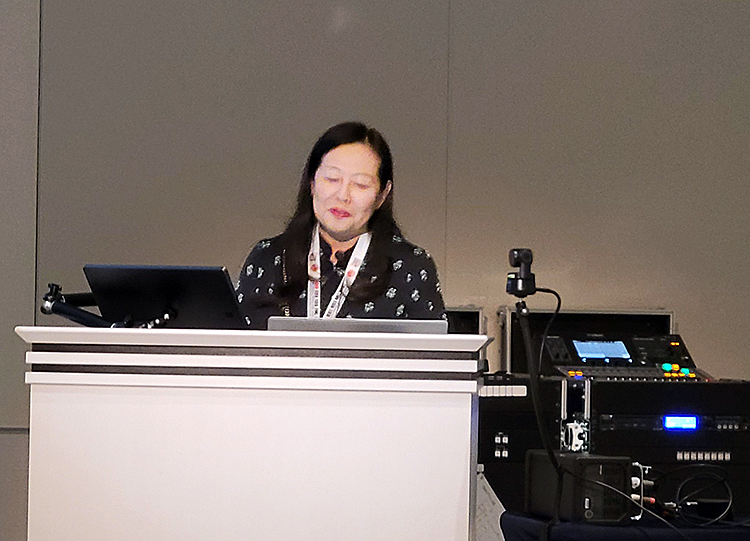
Our guest speaker, Professor Kaoru Sumi, Future University Hakodate, Japan, received her Ph.D. from the University of Tokyo and has broad experience in both industry and academia. Her research interests include intelligent systems, human–agent interaction, affective computing, persuasive technology, Artificial Intelligence (AI) in education, and interactive digital storytelling. She has held visiting positions internationally, including Visiting Professor at the University of British Columbia in 2018, and serves as Invited Research Fellow at the University of Alcalá, Spain, during 2025. She actively contributes to the IEEE community as Chair of IEEE Sapporo WIE (2020–present) and WIE Coordinator for IEEE Japan Council (2025–present). She is General Chair of Persuasive 2026 and a Senior Member of both Association for Computing Machinery (ACM) and IEEE.
Professor Sumi studies how humans interact with AI and robots, including virtual avatars. She explained how virtual avatars can be used as tutors for virtual classrooms; however, avatars may be perceived differently by the students based on their appearance-such as human-like or anime-like faces. Professor Sumi noted a preference from boys for female avatars, while girls preferred gender agnostic non-humanoid appearances. She continued with an intriguing animation involving geometrical shapes and explained that we as humans attribute emotions to just about anything. In this case, we interpreted the movement of the big triangle as bullying a smaller triangle, even with no human-like appearance. This peculiarity of humans can be used to persuade us into certain behaviors. For example, humans are more inclined to help a weak-looking robot to pick up garbage. Finally, she discussed the perceived trustworthiness of various avatars, where children would believe false facts more when they were presented by avatars with human like appearances, particularly male appearances, and believed less false facts when they were presented by characters with cartoon-like appearances. This generated a lot of discussion about the internalized biases and how fake news are propagated.
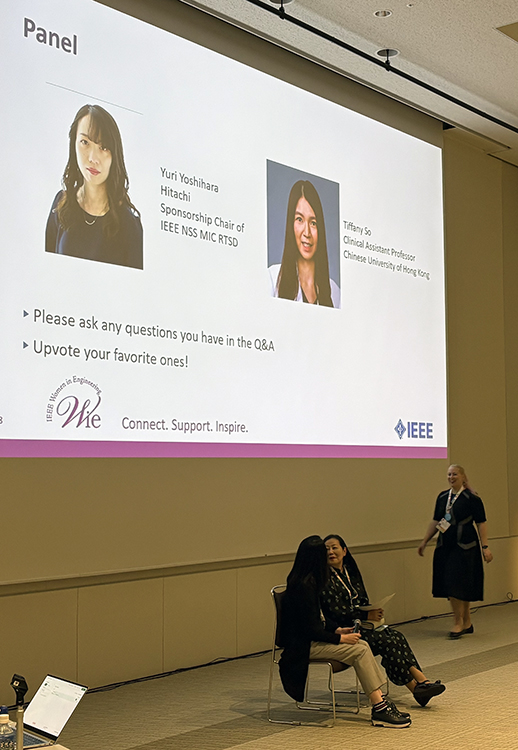
The presentation was followed by a discussion panel chaired by Prof. Corbeil Therrien and co-chaired by Dr. Andrea Gonzalez-Montoro from the Institute for Instrumentation in Molecular Imaging (I3M), Spain.
In the panel, Professor Sumi was joined by Dr. Yuri Yoshihara, Senior Researcher at Hitachi, and our very own IEEE NSS MIC RTSD Sponsorship Chair. Dr. Yoshihara develops high-energy X-ray Computed Tomography (CT) technologies, especially for evaluating complex nuclear-related materials retrieved from the Fukushima Daiichi Nuclear Power Station. A third panelist was invited, Dr. Tiffany So, from the Chinese University of Hong Kong, but was regrettably unable to join us due to unforeseen circumstances.
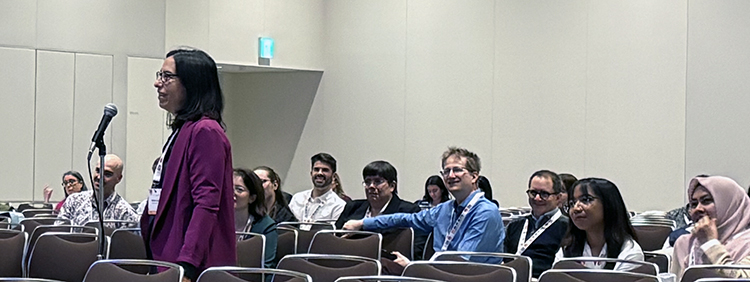
Both Professor Sumi and Dr. Yoshihara have been IEEE members for several years. They revealed that IEEE was most beneficial in forming new connections and building their network. This introductory reflection was followed by an enriching discussion about working as a woman in research, in a field where men are still the majority, as is the case in Japan. They highlighted the importance for IEEE conferences to host WIE events to encourage discussion and networking. The last part of the panel was open to questions from the audience, who had very relevant questions for our panel. It is worth highlighting that both in-person attendees participated with live questions and remote participants had the ability to ask questions through Slido. The panelists were asked about the different expectations and traditional roles for woman in Japan, and had further discussion about the difficulties is having open discussions with male colleagues.
The event ended with a warm lunch and a networking activity where participants could continue the discussions sparked during the panel and make new connections with fellow participants.
The event was greatly appreciated by everyone who attended. Many mentioned the things they learned from Professor Sumi’s presentation about persuasion and perceptions, as well as the new knowledge about Japanese culture that were discussed during the panel. Professor Sumi and Dr. Yoshihara both greatly appreciated their experience and highlighted the great audience engagement during the panel. Overall, a greatly successful event and we thank all the participants for making this an event to remember.
Audrey Corbeil Therrien can be reached by e-mail at [email protected]