2025 IEEE Brain Discovery and Neurotechnology Workshop
IEEE Brain Hosts, NPSS participates

Advances in understanding of the brain in healthy individuals and in those suffering from disorders is leading to groundbreaking discoveries and engineering solutions. Development and deployment of effective neurotechnology and means of studying the brain through neuroimaging techniques and machine learning requires an integrated approach as well as close collaboration among the neuroengineering community, neuroscientists, and clinical practitioners, including NPSS expertise in medical imaging and data analysis.
The 2025 IEEE Brain Discovery and Neurotechnology Workshop was held 12–13 September 2025 at Simon Fraser University, Vancouver, BC, Canada. It brought together researchers and practitioners across academia, industry, and the clinical profession, and highlighted innovative neurotechnology and brain research methods, emphasizing their potential to improve understanding of the brain and address a wide range of disorders to improve the human condition. The workshop was co-chaired by Vesna Sossi (University of British Columbia), Past-President, IEEE NPSS, and Ljiljana Trajkovic (Simon Fraser University, Canada), IEEE Brain 2025 Chair and Past-President, IEEE Systems, Man, and Cybernetics Society, with Martin McKeown (University of British Columbia) serving as local chair.
The program consisted of three tracks: Emerging Neurotechnologies, Machine Learning and Computer Paradigms for Brain Discovery, and Clinical Applications and Impact. Each track hosted a keynote speaker and invited speakers exemplifying the breadth and relevance of IEEE Brain-related topics. Guy Dumont (University of British Columbia) and Rikky Muller (UC Berkeley) served as track co-chairs for emerging neurotechnologies; Tiago Falk (INRS-EMT, University of Quebec) and Jane Wang (University of British Columbia) served as co-chairs of the Machine Learning and Computer Paradigms for Brain Discovery track, while Martin McKeown (University of British Columbia), Ravi Hadimani (Virginia Commonwealth University), and Jose Contreras-Vidal (University of Houston) served as co-chairs of the Clinical Applications and Impact track.
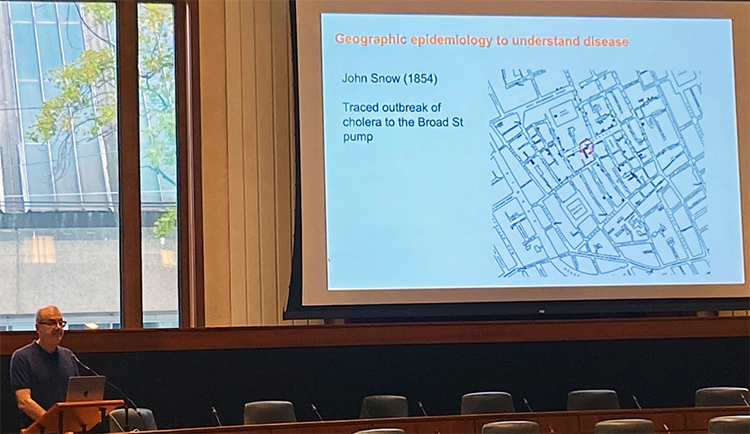
An interesting note which highlights the long term impact of NPSS expertise: the opening address talk on the second day was given by Dr. Alain Dagher, now a prominent neurologist and attending physician at the McGill University Health Centre and Montreal Neurological Institute. He completed his engineering education and training under the supervision of Christopher J. Thompson, a pioneer in Positron Emission Tomography instrumentation, and a well-respected and much cherished pillar of the NPSS Nuclear Medical and Imaging Sciences (NMISC) community. Dr. Dagher’s talk was a perfect balance between description of technological developments and demonstration of their impact in medicine. A podcast featuring an interview with Dr. Dagher is being prepared and will be posted on the NPSS website.
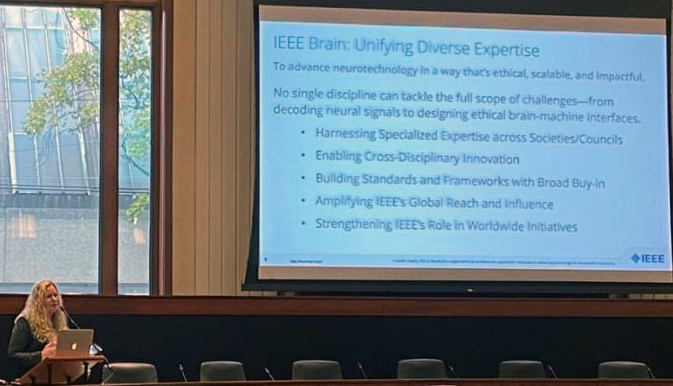
Other program highlights included a panel session on the ethical implications of neurotechnology and the development of standards and a panel exploring clinical priorities and challenges. The workshop also featured a special inter-society panel where representatives from multiple IEEE Societies and IEEE Standard Association discussed the connections between their organization units (OUs) and the mission of IEEE Brain: Keshab Parhi, Circuits and Systems Society, Li-Wei Ko, Computational Intelligence Society, Metin Akay, Engineering Medicine & Biology Society (2024 IEEE Brain Chair), Anahita Kyani, Engineering Medicine & Biology Society Women in Engineering Chair, Ravi Hadimani, Magnetics Society, Vesna Sossi, Nuclear and Plasma Sciences Society, Tulay Adali, Signal Processing Society (2023 IEEE Brain Chair), Milin Zhang, Solid State Circuits Society, Tiago Falk, Systems, Man, and Cybernetics Society, Maria Palombini, Director, Healthcare and Life Sciences Global Practice Lead, Standards Association. The panel was introduced by IEEE President Kathleen Kramer who participated in the discussion and provided an exciting description of the mission and vision of IEEE and the importance of inter-society collaborations.

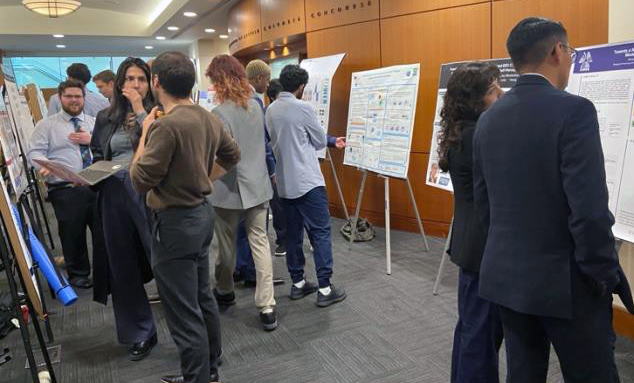
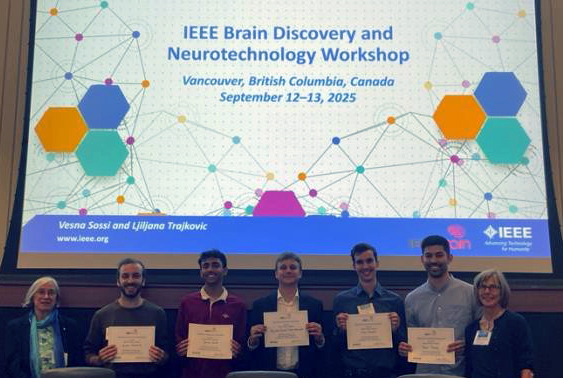
A lively student poster and live demonstration session was held on Saturday, September 13. Five students received awards for Best Posters in the track categories during the final ceremony. These included (from left to right in the photo below, pictured with the workshop co-chairs): Jordan Hanania (University of British Columbia), Dhruv Vaish (University of California Berkeley), Piotr Nabrzyski (University of Houston), Felix Schwock (University of Washington), and Ryan Takagi (University of British Columbia). The trainees valued not only feedback from the experts in their own area, but also the opportunity to learn about innovations in the other tracks. The awardees also agreed to be interviewed for a podcast – this will appear on our website as well.
Overall, attendees were excited by the diverse program and appreciated the opportunity to make new connections across fields and IEEE Societies. Importantly, several non-IEEE member attendees voiced their appreciation not only for IEEE Brain, but also for the very broad expertise and technical portfolios of the different IEEE OUs and the collective synergy. The next IEEE Brain Discovery and Neurotechnology Workshop will be held in Washington DC, USA, in November 2026.
More information about the 2025 workshop is available at https://brain.ieee.org/2025-ieee-brain- discovery-neurotechnology-workshop/.
Vesna Sossi can be reached at [email protected]